Why Classroom Display Differentiation Is Broken and What Comes Next
Walk into most classrooms today and, at first glance, the technology tells a reassuring story. Large interactive displays sit at the front of the room, sharper and more powerful than ever. Specifications have steadily improved year after year, and on paper, the category looks like it is advancing quickly.
But spend a little longer in that same classroom and a different story begins to emerge.
Watch how the display is actually used. Notice where the teacher stands. Pay attention to the small interruptions that happen during a lesson. Switching inputs. Returning to a device. Adjusting controls. Waiting for something to connect.
None of these moments are dramatic. But together, they shape the rhythm of teaching in ways that are easy to overlook and hard to ignore.
Because despite all the progress in hardware, many classrooms are still working around their technology rather than being supported by it.
The issue is not capability. It is alignment.
Teaching has changed significantly over the past decade. Classrooms are no longer built around a single point of delivery. Teachers move constantly. They circulate, engage directly with students, shift between instruction and discussion, and adapt in real time to what is happening in the room.
Learning itself has become more participatory. Students contribute more. Content moves between devices more fluidly. Lessons are less linear and more responsive.
And yet, much of the technology in the classroom still reflects an older model. One where the teacher is positioned at the front, anchored to a device, and responsible for managing the display as much as delivering the lesson.
That gap between how classrooms operate and how displays are designed is where friction begins.
For a long time, differentiation in displays has been defined by performance. Higher resolution. Faster processing. More features layered on top of one another. These are important advances, but they do not address the core experience of teaching.
Teachers do not think in terms of specifications. They think in terms of flow.
Can I start the lesson without delay?
Can I move around the room without losing control?
Can I keep momentum without stopping to manage the technology?
These are the questions that matter in practice. And they are the questions that many current setups still struggle to answer.
What becomes clear, when you look closely, is that the barriers to better teaching experiences are rarely about what technology cannot do. They are about the constraints it introduces.
A cable that ties a teacher to one position.
An interface that interrupts the flow of a lesson.
A system that requires attention at exactly the wrong moment.
Individually, these constraints seem small. Collectively, they influence behaviour. They shape where teachers stand, how they move, and how easily they can respond to the needs of the classroom.
This is why the conversation around display innovation needs to evolve.
Flexibility is often talked about as a feature, but in reality it is something more fundamental. It is the absence of friction. It is what happens when the technology stops dictating behaviour and starts adapting to it.
At DisplayNote, this shift is becoming increasingly clear. The role of the display is changing. It is no longer enough for it to be a high-performance focal point at the front of the room. It needs to function as part of a broader, more fluid experience.
In practical terms, that means thinking of the display not as a destination, but as an extension of the teacher.
When that happens, the dynamic of the classroom changes in subtle but important ways. Teachers are able to move more naturally, engaging with students without breaking their connection to the content. Transitions become smoother. The lesson maintains its rhythm.
Technology begins to recede into the background, which is where it is most effective.
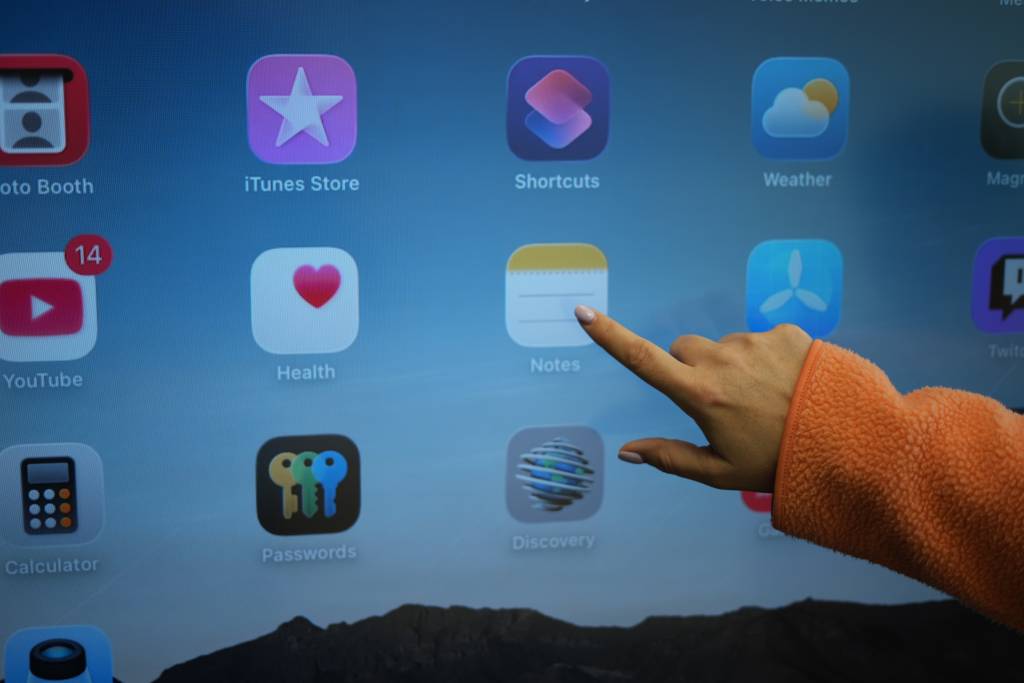
We are starting to see this shift reflected in the way new interaction models are emerging. Developments such as AirPlay Touchback point toward a more integrated experience, where the boundary between personal device and shared display becomes less rigid.
Instead of presenting from a device and then returning to it to make changes, teachers can interact with their content directly from the display itself. They can remain mobile, maintain control, and keep the lesson moving without interruption.
It is a small change in capability, but a significant change in experience.
For display vendors, this has important implications.
The next phase of differentiation will not be defined by pushing hardware specifications further. It will be defined by how well the overall experience supports the realities of teaching.
That means understanding the classroom not as a static environment, but as a dynamic one. It means recognising that flexibility is not something that can be measured on a datasheet. It is something that is felt in the moment, through ease of use, freedom of movement, and continuity of flow.
Vendors who focus on reducing friction, integrating more seamlessly with existing devices, and enabling more natural interaction will be better positioned to meet these expectations.
Because when the constraints are removed, the impact is immediate.
Lessons flow more easily.
Teachers engage more directly.
Students participate more actively.
And the technology, instead of being a focal point, becomes almost invisible.
That is the real opportunity.
Not to build more powerful displays, but to create experiences that adapt to the people using them.
In that context, flexibility is not just another feature to promote. It becomes the defining characteristic of a display that truly supports modern teaching.
And for vendors looking to stand out in an increasingly crowded market, that shift may prove to be the most important one yet.



Want to stay in the loop?
Keep up-to-date with everything DisplayNote – including new releases, job openings, and customer giveaways.
You are currently unable to join our mailing list - if you would like to get in touch please check out our contact page.
Don’t worry, we’ll not spam you and we’ll never share your email with anyone